YQQEWI vs JUCMJXQEQ Heatsinks: Which Brand Fits You?
As an Amazon Associate we earn from qualifying purchases. Links on this page are affiliate links.
This YQQEWI vs JUCMJXQEQ heatsink comparison looks at two server-grade cooling solutions. Both units are designed for active cooling in server environments and feature black or neutral finishes without RGB lighting. The main difference lies in their target socket and form factor. You are choosing between a high-TDP SP5 cooler and a lower-TDP LGA 2011 narrow radiator option. Each serves a distinct hardware requirement.
Key differences
| Aspect | YQQEWI 4U SP5 Active Server Cooler | JUCMJXQEQ 2U Narrow LGA 2011 Heatsink |
|---|---|---|
| Socket Compatibility | SP5 | LGA 2011 Narrow |
| System Type | Server | Server |
| TDP Rating | 400W | 150W |
| Form Factor | 4U | 2U |
| Heat Pipes | not listed | 4 heat pipes |
| Dimensions | 0.39 inches (WxHxL) | 56mm x 94mm mounting pitch |
Which one should you choose?
Choose YQQEWI 4U SP5 Active Server Cooler if
- You need a cooler for an SP5 server socket
- Your server chassis supports 4U height
- Your CPU has a 400W TDP rating
Choose JUCMJXQEQ 2U Narrow LGA 2011 Heatsink if
- You are building with an LGA 2011 Narrow socket
- Your system requires a 2U low-profile form factor
- Your CPU draws around 150W of power
Verdict: Choose the YQQEWI unit if you are deploying high-performance SP5 servers that require 4U space and can handle 400W loads. Pick the JUCMJXQEQ heatsink for LGA 2011 Narrow systems where space is tight and power consumption stays near 150W. The right choice depends entirely on your socket type and chassis dimensions.
Server Cooler Specs Compared
Socket compatibility
You must match the cooler to your processor socket. The YQQEWI unit supports the SP5 socket, which is standard for newer AMD server platforms. This makes it suitable for modern EPYC systems. The JUCMJXQEQ heatsink is designed for LGA 2011 Narrow, a socket type found in older Intel Xeon E5-2600 v3 and v4 processors. These sockets are not interchangeable. You need to verify your motherboard socket before buying. If you have an SP5 board, this cooler is your only option. If you use LGA 2011, you must choose the JUCMJXQEQ model.
System type
Both units are built for server environments, not home desktops. The YQQEWI cooler is explicitly labeled for server CPUs and uses an active cooling method. It is designed to handle high thermal loads in data centers. The JUCMJXQEQ heatsink is also intended for server use, specifically for narrow type radiators in 2U chassis. Both rely on active cooling, meaning they require fans to operate. You cannot use these as passive coolers. Your server chassis must accommodate the specific height and mounting requirements of each unit.
TDP rating
Thermal Design Power indicates how much heat the cooler can dissipate. The YQQEWI cooler has a stated TDP of 400W. This high rating suggests it is built for high-performance server processors that generate significant heat. The JUCMJXQEQ heatsink is rated for 150W. This lower rating fits older or lower-power server CPUs. You should match the TDP to your CPU's actual heat output. A 400W cooler might be overkill for a 150W chip, while a 150W cooler will fail on a 400W chip.
Form factor height
Server chassis have strict height limits. The YQQEWI cooler is a 4U unit, which is quite tall. It requires a chassis with 4U of vertical space. The JUCMJXQEQ heatsink is a 2U unit, which is half the height. It is designed for denser 2U server racks. You must measure your available space. If you are using a 2U rack, the YQQEWI unit will not fit. The JUCMJXQEQ is the correct choice for compact 2U systems. The YQQEWI is better for larger 4U enclosures.
Heat pipe count
Heat pipes transfer heat from the CPU to the fins. The JUCMJXQEQ heatsink features four heat pipes, as noted in its description. This configuration helps spread heat across the fins more effectively. The YQQEWI product data does not list the number of heat pipes. We cannot compare this specific feature directly. You should check the physical product or manufacturer details for the YQQEWI pipe count. For now, the JUCMJXQEQ has a documented advantage in this specific specification.
Which heatsink fits your server build
You use modern AMD EPYC SP5 servers
The YQQEWI cooler is built for the SP5 socket. It handles a 400W TDP, which suits high-performance AMD EPYC processors. The 4U height allows for larger fins. This matches your hardware needs directly without requiring adapters or incompatible mounts.
You run Intel LGA 2011 narrow platforms
The JUCMJXQEQ heatsink supports the LGA 2011 narrow socket. It fits 2U server chassis with a 56mm x 94mm mounting pitch. The four heat pipes help dissipate up to 150W. This specific fit ensures proper contact and cooling for your older Intel server CPU.
You need high density 2U server cooling
If your server rack uses 2U slots, this heatsink is the correct form factor. The narrow radiator type saves space. It is designed for 150W loads. The compact 56mm x 94mm footprint ensures it fits within tight server chassis constraints where larger coolers would not fit.
The products compared
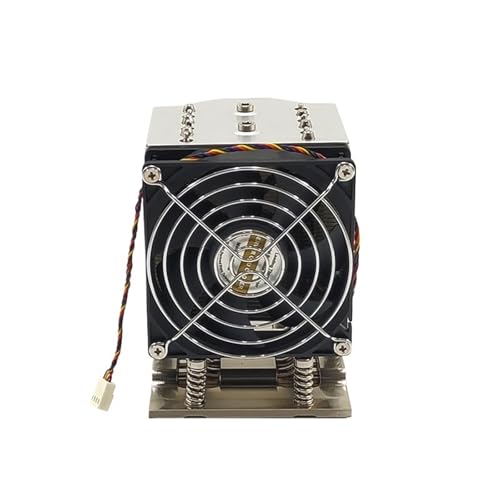
YQQEWI 4U SP5 Active Server Cooler
Best for: SP5 server builds in 4U chassis
- Socket Compatibility
- SP5
- Server Height
- 4U
- Cooling Method
- Active
- Compatible Device
- Server CPU
- Lighting
- RGB
- Color
- Black
View on Amazon: YQQEWI 4U SP5 Active Server Cooler Affiliate link
This YQQEWI heatsink is an active cooling solution designed for SP5 server sockets. It handles a TDP of 400W and fits into 4U server chassis. The unit is black and includes RGB lighting. It weighs 1.76 ounces and measures 0.39 inches in width, height, and length. You need this for high-power server CPUs that require dedicated active cooling in a 4U form factor.
Pros
- Supports 400W TDP for high-performance server CPUs
- Compatible with SP5 socket
- Includes RGB lighting
- Active cooling method
Cons
- Limited to SP5 socket compatibility
- Specific 4U form factor restricts use to server chassis
- Small physical dimensions may not fit standard desktop cases
Good fit if
- You are building a server with an SP5 processor
- You need a heatsink rated for 400W TDP
- Your chassis supports 4U height
Skip if
- You use a consumer desktop CPU socket
- You require a low-profile cooler for a small form factor
- You need passive cooling only
Verdict: YQQEWI SP5 4U Server Heatsink fits server builders who need 400W cooling for SP5 sockets in 4U cases. It does not suit desktop users.

JUCMJXQEQ 2U Narrow LGA 2011 Heatsink
Best for: 2U LGA 2011 Narrow socket servers
- Socket Compatibility
- LGA 2011 Narrow
- Server Height
- 2U
- Lighting
- RGB
View on Amazon: JUCMJXQEQ 2U Narrow LGA 2011 Heatsink Affiliate link
This JUCMJXQEQ heatsink is built for LGA 2011 Narrow sockets in 2U server chassis. It features a 56mm x 94mm mounting pitch and four heat pipes. The unit supports 150W TDP and includes RGB lighting. You need this cooler for narrow-type radiator setups. It fits specific 2U server requirements. Check your socket and height constraints before buying.
Pros
- Compatible with LGA 2011 Narrow sockets
- Designed for 2U server height constraints
- Includes four heat pipes for heat transfer
- Features RGB lighting
- Supports 150W TDP
Cons
- Limited to LGA 2011 Narrow socket type
- Specific 56mm x 94mm mounting pitch
- Only supports 150W TDP
Good fit if
- You use an LGA 2011 Narrow socket
- You have a 2U server chassis
- You need a 150W rated heatsink
Skip if
- You have a different socket type
- You require a taller chassis clearance
- You need higher than 150W TDP support
Verdict: JUCMJXQEQ 2U LGA 2011 Heatsink fits users with narrow LGA 2011 sockets in 2U servers. It provides necessary cooling for 150W loads with RGB lighting.
Specifications side by side
| Spec | YQQEWI 4U SP5 Active Server Cooler | JUCMJXQEQ 2U Narrow LGA 2011 Heatsink |
|---|---|---|
| Socket Compatibility | SP5 | LGA 2011 Narrow |
| Server Height | 4U | 2U |
| Cooling Method | Active | not stated |
| Compatible Device | Server CPU | not stated |
| Lighting | RGB | RGB |
| System Type | Server | not stated |
| Color | Black | LGA2011-R63-3 |
| Dimensions | 0.39 × 0.39 × 0.39 inches | not stated |
| Weight | 1.76 ounces | not stated |
| Size | NO RGB | NO RGB |
| Model | YQQEWI | JUCMJXQEQ |
Frequently asked questions
Can I use the YQQEWI cooler on a desktop PC?
No. The YQQEWI 4U SP5 Active Server Cooler is designed strictly for server builds. It targets SP5 sockets in 4U chassis units. Desktop users will not find compatibility with standard consumer motherboards. The form factor and socket support are specific to enterprise server environments.
Does the JUCMJXQEQ heatsink support LGA 1700 sockets?
No. The JUCMJXQEQ 2U Narrow LGA 2011 Heatsink is built for LGA 2011 sockets. It does not support Intel LGA 1700 processors. You must ensure your server uses the LGA 2011 narrow socket layout to fit this cooler properly.
What is the maximum thermal design power for the YQQEWI model?
The YQQEWI cooler supports up to 400W of thermal power. This capacity suits high-performance AMD EPYC processors. The 4U height allows for larger fins to dissipate this heat. It is not intended for lower-power desktop CPUs.
Is RGB lighting included with the JUCMJXQEQ heatsink?
Yes. The JUCMJXQEQ unit features RGB lighting. This is useful for visibility in dark server racks. The cooler is designed for 150W loads in 2U servers. The lighting does not affect cooling performance but aids in identification.
Which heatsink is better for a 2U server chassis?
The JUCMJXQEQ 2U Narrow LGA 2011 Heatsink fits 2U chassis. The YQQEWI unit requires a 4U space. If your server is 2U height, the JUCMJXQEQ is the only compatible option. It provides necessary cooling for 150W loads in that form factor.
Does the YQQEWI cooler have a black finish?
Yes. The YQQEWI 4U SP5 Active Server Cooler has a black color finish. This is standard for server-grade hardware. The black finish helps it blend into server racks. It is a passive aesthetic choice that does not impact thermal performance.