What Is Material? A Guide for CPU Coolers Buyers (2026)
As an Amazon Associate we earn from qualifying purchases. Links on this page are affiliate links.
Understanding Cooler Material Specs
When you shop for a CPU air cooler, you will see two main metals listed. These are copper and aluminum. Knowing the difference helps you choose the right part for your build. This guide covers material explained so you can make an informed decision without guesswork.
Copper is the standard for high performance. It conducts heat away from the processor much faster than other common metals. You will often find copper in the base of the cooler. This is the flat part that touches your CPU. Some high-end models also use copper heat pipes. These pipes move heat from the base to the fins quickly. Copper is heavy and dense. It feels solid in your hands. If you want the best thermal transfer, copper is the top choice.
Aluminum is lighter and cheaper. You will see it used in the fins. Fins are the thin plates that stick up from the base. They increase the surface area to release heat into the air. Many coolers use a mix of both metals. A copper base paired with aluminum fins is very common. This setup balances cost and performance. Aluminum does not conduct heat as well as copper. However, it is easier to shape into thin fins.
Thermal paste also uses specific materials. Look for descriptions that mention metal particles or ceramic compounds. These additives help fill microscopic gaps between the cooler and the CPU. This ensures better contact. Poor contact means higher temperatures. Always check the spec sheet for the base material. It is the most critical factor for cooling efficiency. You want maximum heat transfer to keep your processor safe during heavy loads.
Copper vs Aluminum Materials
Copper
Copper conducts heat faster than other common metals. This means it moves thermal energy away from the CPU core more efficiently. You will find this material in high-performance coolers and specific legacy parts like the Ultra Socket 775 Copper Core CPU Cooler. The trade-off is weight. Copper is dense, so these coolers are heavier. This extra mass can help with thermal inertia, but it requires sturdy motherboard mounting. It is best for users who prioritize maximum heat transfer speed and do not mind the added weight in their case.
Aluminum
Aluminum is lighter and cheaper to manufacture than copper. It is the standard for budget and low-profile coolers. The StarTech.com 50mm Socket 7/370 Aluminum Cooler shows how this material fits small form factors easily. Because it is lighter, it puts less stress on the CPU socket. However, it does not conduct heat as quickly as copper. You will see aluminum fins on many modern designs to increase surface area. This material suits users who need a lightweight, compact solution for older sockets or tight spaces where maximum thermal speed is less critical than size and weight.
Is Material Choice Worth It?
Who needs it
You should prioritize the material spec if you run a high-TDP processor or plan to overclock. Copper’s superior thermal conductivity allows it to absorb and transfer heat away from the CPU core more efficiently than aluminum. This rapid heat transfer is critical when your processor generates significant thermal energy. If you push your system to its limits, the extra performance gained from copper can prevent thermal throttling. You will find copper in high-performance coolers designed for intense workloads. Choosing a copper-heavy base ensures better heat dissipation during sustained loads. This material choice matters most when every degree of temperature reduction counts. If your build involves heavy rendering, gaming, or data processing, the thermal efficiency of copper justifies the selection. It provides a more robust thermal solution for demanding environments where stability is paramount.
Who can skip it
You can ignore the material distinction if you use a standard office CPU or a low-power mobile chip. Aluminum offers adequate cooling for systems with modest thermal output. The performance gap between copper and aluminum is negligible in these scenarios. Prioritize fan quality, heat pipe count, and tower size instead. These factors often influence airflow and overall cooling capacity more than the base metal alone. If your budget is tight, aluminum coolers provide sufficient performance for general computing tasks. You do not need the premium thermal properties of copper for light workloads. Focus on fitment and clearance within your case rather than the specific metal composition. The difference in cooling efficiency will not impact your daily usage. Stick to aluminum if your processor stays within its stock thermal limits. This allows you to allocate resources to other components that benefit your build more significantly.
Cooler Material Glossary
Copper Base
A solid copper block attached to the CPU. It absorbs heat quickly due to high conductivity, making it ideal for high-TDP processors.
Aluminum Fins
Thin metal plates that increase surface area for air cooling. They are lighter and cheaper than copper but transfer heat slightly slower.
Heat Pipe
A sealed tube containing fluid that moves heat from the base to the fins. Copper pipes are standard for efficient thermal transfer.
Nickel Plating
A thin coating applied to aluminum fins. It prevents corrosion and gives the cooler a shiny, silver appearance without adding weight.
Thermal Conductivity
A measure of how fast a material moves heat. Copper has a higher rating than aluminum, allowing for faster cooling performance.
TDP Rating
The maximum heat output a cooler can handle, measured in watts. You should match this spec to your processor’s power requirements.
Socket Compatibility
The list of CPU mounts a cooler supports, such as LGA 1700 or AM5. Always verify this before buying to ensure a fit.
Quick picks
| # | Product | Best for | Price |
|---|---|---|---|
| 1 | Ultra Socket 775 Copper Core CPU Cooler | Legacy LGA 775 systems | Check price of Ultra Socket 775 Copper Core CPU Cooler on Amazon |
| 2 | StarTech.com 50mm Socket 7/370 Aluminum Cooler | Socket 7 and 370 legacy system cooling | Check price of StarTech.com 50mm Socket 7/370 Aluminum Cooler on Amazon |
| 3 | Akasa 92mm Copper Core CPU Cooler | quiet cooling on older Intel LGA platforms | Check price of Akasa 92mm Copper Core CPU Cooler on Amazon |
| 4 | Thermaltake Gravity i2 92mm CPU Cooler | Intel LGA 115x/1200 low-profile builds | Check price of Thermaltake Gravity i2 92mm CPU Cooler on Amazon |
| 5 | Dynatron 2U Active Server CPU Cooler | LGA 115X/1200 2U server builds | Check price of Dynatron 2U Active Server CPU Cooler on Amazon |
| 6 | TRONSTORE TS1 92mm CPU Cooler | Basic Intel LGA 115x/1200 desktop cooling | Check price of TRONSTORE TS1 92mm CPU Cooler on Amazon |
Our 6 picks

Ultra Socket 775 Copper Core CPU Cooler
Best for: Legacy LGA 775 systems
- Material
- Copper (what this guide is about)
- Socket Compatibility
- Socket 775
- Fan Speed
- 3600 RPM
- Features
- Fan
- Dimensions
- 9.7 × 3.7 × 7.1 inches
- Weight
- 1 pounds
View on Amazon: Ultra Socket 775 Copper Core CPU Cooler Affiliate link
This Ultra P4 cooler uses a copper core with aluminum fins to manage heat on Socket 775 systems. It features a fan that spins at 3600 RPM and supports PWM speed control. The sleeve bearing motor and compact 3.7-inch width make it suitable for older platforms. You get direct copper contact for efficient thermal transfer without the bulk of larger modern designs.
Pros
- Copper core heatsink construction
- Aluminum fins for surface area
- 3600 RPM fan speed
- PWM fan speed control
- Socket 775 compatibility
Cons
- Sleeve bearing limits lifespan compared to fluid dynamic bearings
- Only supports legacy Socket 775
- Single fan configuration
Good fit if
- You are upgrading an older LGA 775 system
- You need a compact 3.7-inch wide cooler
- You prefer copper core thermal performance
Skip if
- You use a modern Socket 1700 or AM5 platform
- You require quiet operation below 3600 RPM
- You need a cooler for high TDP processors
Verdict: Ultra P4 Socket 775 Copper Core Cooler is a specialized solution for legacy LGA 775 builds. It offers reliable copper-core cooling for older processors that no longer require massive modern coolers.
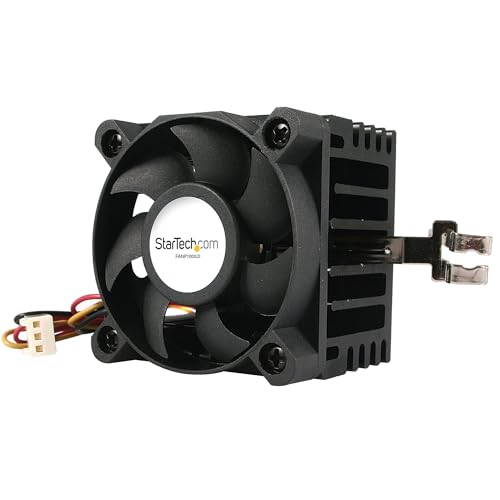
StarTech.com 50mm Socket 7/370 Aluminum Cooler
Best for: Socket 7 and 370 legacy system cooling
- Material
- Aluminum (what this guide is about)
- Socket Compatibility
- Socket 370, Socket 7
- Fan Size
- 50 mm
- Color
- Black
- Features
- Fan
- Dimensions
- 1.97 × 1.61 × 1.97 inches
View on Amazon: StarTech.com 50mm Socket 7/370 Aluminum Cooler Affiliate link
This StarTech.com cooler is designed for legacy Socket 7 and Socket 370 processors. It uses an aluminum heatsink and includes a 50 mm fan. The compact dimensions are 1.61 x 1.97 x 1.97 inches. It weighs 8 ounces. You will find this unit suitable for older systems that require small form factor cooling solutions. The aluminum material helps dissipate heat effectively for low-power CPUs.
Pros
- Compatible with Socket 7 and Socket 370
- Includes a 50 mm fan
- Constructed from aluminum material
- Compact 1.61 x 1.97 x 1.97 inch size
Cons
- Very small 50 mm fan limits airflow
- Aluminum heatsink has lower thermal conductivity than copper
- Limited to older Socket 7 and 370 platforms
Good fit if
- You are building or repairing a Socket 370 system
- You need a replacement cooler for legacy hardware
- You have strict space constraints under 2 inches
Skip if
- You use modern Socket 1700 or AM5 processors
- You require high cooling performance for overclocking
- You prefer copper heatsinks for better heat transfer
Verdict: StarTech 50mm Socket 370 Aluminum Cooler is a niche solution for Socket 7 and 370 systems. It fits users who need a small, functional cooler for older hardware rather than high-end performance.

Akasa 92mm Copper Core CPU Cooler
Best for: quiet cooling on older Intel LGA platforms
- Material
- Copper (what this guide is about)
- Socket Compatibility
- LGA 1200/1151/1150/1155/1156/775
- Fan Size
- 92mm
- TDP Rating
- 115W
- Features
- Fan
- Dimensions
- 3.74 × 3.74 × 2.44 inches
View on Amazon: Akasa 92mm Copper Core CPU Cooler Affiliate link
The Akasa Copper Core is a 92mm air cooler designed for Intel sockets up to 115W TDP. It features a copper core base with aluminum fins for efficient heat transfer. The included PWM fan adjusts speed based on CPU load to maintain quiet operation. It uses a rolling bearing for longevity and Intel-approved pushpins for straightforward installation on LGA 1200 and older sockets.
Pros
- Copper core base for effective heat conduction
- 92mm PWM fan for adjustable noise levels
- Rolling bearing supports up to 40,000 hours of use
- Pushpin installation requires no mounting adjustment
- Compatible with LGA 1200, 1151, 1150, 1155, 1156, and 775
Cons
- 92mm fan size offers lower airflow than standard 120mm or 140mm coolers
- Limited to 115W TDP rating
- No ARGB lighting or software control features listed
Good fit if
- You need a reliable cooler for Intel LGA 1200 or older platforms
- You prioritize quiet operation under normal workloads
- You want a simple pushpin installation without complex mounting brackets
Skip if
- You require compatibility with modern LGA 1700 sockets
- You need cooling for processors exceeding 115W TDP
- You want RGB lighting customization or software control
Verdict: Akasa Copper Core 92mm CPU Cooler is a practical, no-frills solution for Intel users on older sockets who need reliable cooling without complexity. It fits well for budget builds or systems where quiet operation is more important than maximum thermal headroom.

Thermaltake Gravity i2 92mm CPU Cooler
Best for: Intel LGA 115x/1200 low-profile builds
- Material
- Aluminum (what this guide is about)
- Socket Compatibility
- LGA 1200/1156/1155/1150/1151
- Tower Design
- Low-profile
- Fan Size
- 92mm
- Features
- Fan
- Dimensions
- 3.7 × 2.4 × 3.7 inches
View on Amazon: Thermaltake Gravity i2 92mm CPU Cooler Affiliate link
This Thermaltake cooler uses an aluminum extrusion heatsink for heat dissipation. It pairs with a 92mm, 7-bladed fan that supports 4-pin PWM control. The unit fits Intel sockets including LGA 1200, 1156, 1155, 1150, and 1151. Its low-profile tower design measures 3.7 inches in height. You get a compact cooling solution that balances performance with a small physical footprint for smaller cases.
Pros
- Aluminum extrusion heatsink design
- 92mm 7-bladed fan with low noise
- 4-pin PWM fan connector
- Low-profile 3.7-inch height
- Supports multiple Intel LGA sockets
Cons
- Aluminum material conducts heat less efficiently than copper
- 92mm fan size offers lower static pressure than 120mm fans
- Limited to Intel socket compatibility
Good fit if
- You need a low-profile cooler for a small case
- You use an Intel processor with LGA 115x or 1200 sockets
- You prefer quiet operation from a 92mm fan
Skip if
- You require a copper base for maximum thermal performance
- You use an AMD processor
- You need a high-airflow 120mm or 140mm fan
Verdict: Thermaltake 92mm Low-Profile Aluminum Cooler suits users with Intel LGA 115x or 1200 CPUs who need a compact, low-profile cooling solution that fits in tight spaces without sacrificing basic thermal management.

Dynatron 2U Active Server CPU Cooler
Best for: LGA 115X/1200 2U server builds
- Material
- Copper, Aluminum (what this guide is about)
- Socket Compatibility
- LGA 115X, LGA 1200
- Server Height
- 2U
- Cooling Method
- Active
- Dimensions
- 6 × 6 × 6 inches
View on Amazon: Dynatron 2U Active Server CPU Cooler Affiliate link
This active cooler uses a copper base and aluminum fins with embedded heat pipes. It fits LGA 115X and LGA 1200 sockets. The 2U server height design suits tight spaces. You get dual ball bearings for steady operation. It targets users needing reliable cooling in constrained server or workstation builds.
Pros
- Copper base for efficient heat transfer
- Aluminum fins with embedded heat pipes
- Dual ball bearing fan for durability
- Compatible with LGA 115X and LGA 1200 sockets
Cons
- Limited to LGA 115X and LGA 1200 sockets
- 2U form factor restricts case compatibility
- No mention of PWM fan control
Good fit if
- You need a cooler for LGA 115X or LGA 1200 sockets
- You are building a 2U server or compact workstation
- You prioritize copper base heat transfer efficiency
Skip if
- You use a socket outside LGA 115X or LGA 1200
- You require a standard desktop ATX case cooler
- You need support for modern LGA 1700 or AM5 sockets
Verdict: Dynatron K555 2U Server Cooler is a specialized solution for LGA 115X and LGA 1200 builds in constrained 2U enclosures. It fits users who need reliable active cooling with a copper base in server or workstation environments.

TRONSTORE TS1 92mm CPU Cooler
Best for: Basic Intel LGA 115x/1200 desktop cooling
- Material
- Copper, Aluminum (what this guide is about)
- Socket Compatibility
- Socket 1200, 1151, 1150, 1155, 1156
- Fan Size
- 92mm
- System Type
- Desktop
- Features
- Fan
- Dimensions
- 3.62 × 3.62 × 2.2 inches
View on Amazon: TRONSTORE TS1 92mm CPU Cooler Affiliate link
The TRONSTORE TS1 uses an aluminum heatsink with a copper core base to dissipate heat. It includes a 92mm fan and pre-applied thermal paste for easy installation. The cooler supports Intel sockets 1200, 1151, 1150, 1155, and 1156. You get a 4-pin PWM connector for fan speed control. This compact unit weighs 5.6 ounces and fits desktop systems requiring straightforward cooling for Intel Core processors.
Pros
- Aluminum heatsink with copper core base
- Supports Intel sockets 1200, 1151, 1150, 1155, and 1156
- Includes pre-applied thermal paste
- 92mm fan with 4-pin PWM connector
Cons
- Smaller 92mm fan limits airflow compared to 120mm or 140mm options
- Aluminum fins reduce heat capacity relative to all-copper designs
- No included mounting hardware for AMD sockets
Good fit if
- You need a budget-friendly cooler for Intel LGA 115x or 1200 sockets
- You prefer a compact 92mm fan for smaller cases
- You want a plug-and-play solution with pre-applied thermal paste
Skip if
- You require high-end cooling for overclocked Intel i7 or i9 processors
- You use an AMD motherboard socket
- You need a larger 120mm or 140mm fan for better airflow
Verdict: TRONSTORE TS1 92mm Aluminum Heatsink is a basic cooling solution for Intel desktops. It fits users who need simple, affordable cooling for standard i3, i5, or i7 processors without demanding maximum thermal performance.
Specifications side by side
| Spec | Ultra Socket 775 Copper Core CPU Cooler | StarTech.com 50mm Socket 7/370 Aluminum Cooler | Akasa 92mm Copper Core CPU Cooler | Thermaltake Gravity i2 92mm CPU Cooler | Dynatron 2U Active Server CPU Cooler | TRONSTORE TS1 92mm CPU Cooler |
|---|---|---|---|---|---|---|
| Socket Compatibility | Socket 775 | Socket 370, Socket 7 | LGA 1200/1151/1150/1155/1156/775 | LGA 1200/1156/1155/1150/1151 | LGA 115X, LGA 1200 | Socket 1200, 1151, 1150, 1155, 1156 |
| Tower Design | not stated | not stated | not stated | Low-profile | not stated | not stated |
| Fan Size | not stated | 50 mm | 92mm | 92mm | not stated | 92mm |
| TDP Rating | not stated | not stated | 115W | not stated | not stated | not stated |
| Fan Speed | 3600 RPM | not stated | not stated | not stated | not stated | not stated |
| System Type | not stated | not stated | not stated | not stated | not stated | Desktop |
| Color | not stated | Black | not stated | Black | not stated | not stated |
| Server Height | not stated | not stated | not stated | not stated | 2U | not stated |
| Cooling Method | not stated | not stated | not stated | not stated | Active | not stated |
| Material | Copper | Aluminum | Copper | Aluminum | Copper, Aluminum | Copper, Aluminum |
| Features | Fan | Fan | Fan | Fan | not stated | Fan |
| Dimensions | 9.7 × 3.7 × 7.1 inches | 1.97 × 1.61 × 1.97 inches | 3.74 × 3.74 × 2.44 inches | 3.7 × 2.4 × 3.7 inches | 6 × 6 × 6 inches | 3.62 × 3.62 × 2.2 inches |
| Weight | 1 pounds | 8 ounces | 12.3 ounces | 11 ounces | not stated | 5.6 ounces |
| Model | ult31797 | FANP1003LD | AK-959CU | CLP0556-B | K555 | TS1 |
| Size | not stated | not stated | not stated | Intel | not stated | not stated |
Frequently asked questions
Does a copper base mean the whole cooler is copper?
No. Most coolers use a hybrid approach. The base touching the CPU is often copper for fast heat absorption. The fins that dissipate heat into the air are usually aluminum. This combination balances thermal performance with weight and cost. Some models, like the Dynatron K555, use both materials in different sections.
Is aluminum better for lightweight builds?
Yes. Aluminum is significantly lighter than copper. The StarTech.com 50mm Socket 7/370 Aluminum Cooler weighs only 8 ounces. The Thermaltake Gravity i2 92mm weighs 11 ounces. These low weights make aluminum ideal for small form factor cases or legacy systems where heavy components are impractical.
Which material is better for older Intel sockets?
Copper is often preferred for older platforms due to its conductivity. The Ultra Socket 775 Copper Core Cooler and Akasa 92mm Copper Core Cooler use copper bases. These are designed for legacy LGA 775 and LGA 1200 systems. Copper helps manage heat effectively in systems that may lack advanced airflow.
Do mixed material coolers perform better?
They offer a balance. The TRONSTORE TS1 92mm and Dynatron K555 use both copper and aluminum. The copper base absorbs heat quickly from the CPU. The aluminum fins provide surface area for cooling without adding excessive weight. This setup is common in budget and server-grade coolers for reliable thermal management.
Why do some coolers only list copper as the material?
They likely have a copper base and possibly copper heat pipes. The Akasa 92mm and Ultra Socket 775 models highlight copper for its superior thermal conductivity. This material moves heat away from the processor core faster than aluminum. It is a key spec for buyers prioritizing thermal efficiency over weight.
Is aluminum sufficient for standard desktop CPUs?
Yes. For standard i3, i5, or i7 processors, aluminum is often enough. The TRONSTORE TS1 and Thermaltake Gravity i2 are aluminum-based. They provide adequate cooling for non-overclocked systems. Aluminum fins dissipate heat effectively when paired with a decent fan, making them a practical choice for basic desktop builds.